East German People's Police
The Spy Who Came in from the ColdThe East German People’s Police are the uniformed officers who give the border between East and West its immediate, physical force. In the novel they appear at checkpoints as observers and inspectors, but their routine authority can become deadly: the same apparatus that checks documents and waves traffic onward also watches Karl Riemeck’s attempted escape and provides the setting for his shooting. Their presence makes the Berlin Wall not merely a barrier, but a controlled threshold at which movement depends on surveillance, permission, and the threat of violence.
Identity and Function
The East German People’s Police—referred to in the narrative as the Vopos—are encountered in the border zone, where officers staff huts, watch the road, inspect vehicles, and enforce passage between sectors. The scenes show them not as a distant abstraction but as a visible working force: policemen report vehicles, use binoculars and telescopes, conduct checks, and stand at the line separating one jurisdiction from another. This practical, repeated presence makes the border legible to travelers as a sequence of inspections and decisions.
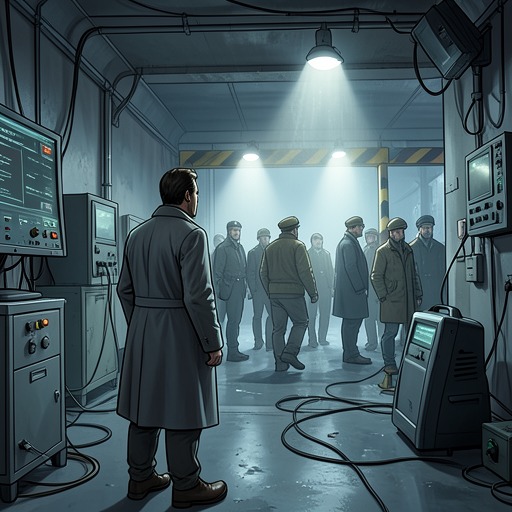
Their authority is distributed among several officers rather than concentrated in a single figure. At the checkpoint where Leamas waits, one policeman goes to a sandbagged emplacement while another puts on his helmet and watches; under the arclights, the officers’ positions and equipment turn the hut into an observation post. The contrast between procedure and force is built into the arrangement: a car may be waved onward after scrutiny, while the sentry on the road can fire at a person attempting to cross.
Checkpoints and Surveillance
The officers’ work is presented through watching and reporting. At one crossing, a policeman announces the arrival of a black Opel Rekord with West German registration. A woman is escorted to the hut for a document check, while Leamas and the others wait for news of what happens next. The announcement converts a distant vehicle into a monitored subject before it reaches the barrier; those inside the hut listen for details and try to infer what the East German officers know.
The inspection of the Opel shows how the process unfolds in small, visible actions. Two officers stand by the driver’s door, one speaking and the other waiting; a third circles the vehicle, asks for the key, opens the boot, looks inside, closes it, and returns the key. He then walks to the solitary sentry between the opposing checkpoints and talks with him under the arclight. The car is eventually waved forward, stopped again by sentries in the middle of the road, and allowed through to the Western sector. Passage is neither a simple opening nor an uninterrupted journey: it is a chain of observation, searches, pauses, and discretionary release.
A separate checkpoint conversation makes clear that the officers are also part of the uncertainty surrounding an escape. One policeman suggests that there are still places where a person can climb over the Wall. Leamas expects Karl to take a different route: he has papers, if they remain valid, and a bicycle, and will try to bluff his way through. That exchange presents the officers’ scrutiny as an obstacle an escapee might attempt to deceive rather than a fixed, impassable line. The possibility of getting through depends on the papers, the conduct of the traveler, and what the people on duty notice.
Karl Riemeck’s Escape and Shooting
The most consequential encounter with the police comes when Karl approaches the crossing on his bicycle. Leamas recognizes him at a distance, wearing an old Wehrmacht macintosh and pushing the bicycle. Karl passes the document check and goes to Customs; after coming out, he waves cheerfully to the man at the barrier, and the red-and-white pole rises. For a moment, it appears that his papers and composure have carried him through the official stages.
The apparent success breaks when Karl senses danger and pedals furiously. Searchlights snap on and hold him in their beam; a siren sounds and orders are shouted. Inside the hut, the two policemen drop to their knees behind the sandbagged slits and load their automatic rifles. The sudden change is stark: the slow routines of inspection give way to coordinated readiness for violence, and the exposed road becomes a field of fire.
The sentry fires into his own sector. The first shot thrusts Karl forward and the second pulls him back, yet he continues moving on the bicycle past the sentry as the shooting continues. He finally sags and falls, and the bicycle clatters to the ground. Leamas hopes Karl is dead. The scene leaves no comfortable distinction between border administration and lethal enforcement: the man who has just passed through the formal checks is still vulnerable to a sentry’s gun before reaching safety.
A Divided City and Its Escalating Controls
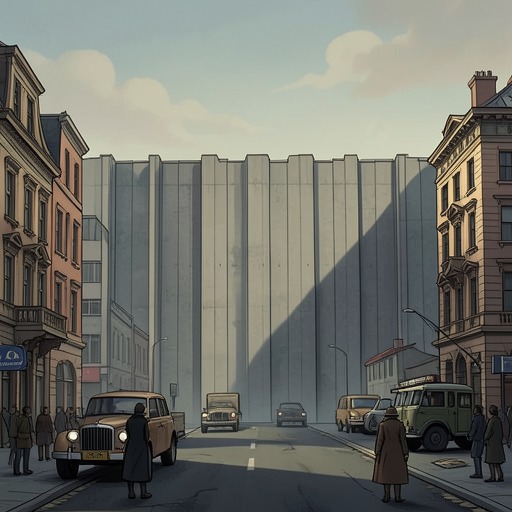
The police presence belongs to a wider system of confrontation around the Wall. In the recollection of the Wall’s construction, East and West Berlin are described as divided by barricades and guarded crossings; at the Friedrichstrasse crossing, American and Soviet Bloc tanks face one another across a strip of road. The police officers’ local work sits within this larger standoff, where a checkpoint is both an everyday instrument of control and a point at which opposing powers may confront one another.
The border is also described as becoming more heavily fortified. When Leamas is later taken across the sector boundary, he sees dragons’ teeth, observation towers, and double aprons of barbed wire on the Eastern side. The cars pass through after a prearranged delay: a DKW goes first, the barrier lifts, and the Mercedes follows through the checkpoint while the Vopos watch through binoculars. Their role in this passage is different from their role in Karl’s escape. Here the crossing is managed to admit Leamas under controlled circumstances; the officers observe the vehicles, but the passage proceeds without a stop at the second checkpoint.
These encounters make the East German People’s Police part of the novel’s larger structure of surveillance and misdirection. Their checks can reveal how closely a traveler is being watched, yet the officers’ visible procedures do not by themselves disclose the whole intelligence operation unfolding around them. For Leamas, the border is at once a physical obstacle, a monitored route, and a passage arranged by others. The police embody the immediate authority of the divided city, while the routes across it remain vulnerable to manipulation by rival intelligence services.